Vehicle pre start checklist: what to check before you drive
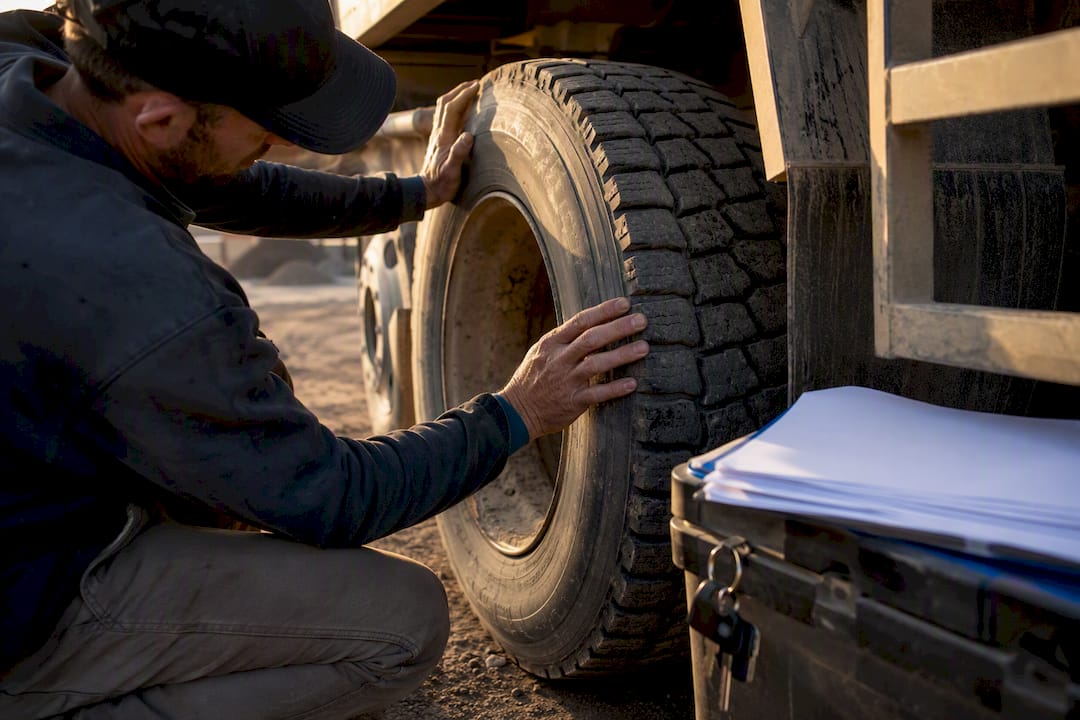
Do a pre-start check before every trip, or at least weekly for pooled vehicles, and record it before you turn the key. Here’s the short version you can use right now: walk around the vehicle checking lights, tyres, mirrors and body damage; pop the bonnet for oil, coolant, belts and leaks; jump in the cab and test gauges, seat belts, wipers and horn; confirm your fire extinguisher, first aid kit and registration are current.
- Outside: lights, indicators, tyres, mirrors, body condition
- Under bonnet: oil level, coolant, belts, visible leaks
- In-cab: gauges, seat belts, wipers, horn, controls
- Safety gear: fire extinguisher, first aid kit, registration paperwork
If anything fails, don’t drive the vehicle. Tag it, notify your supervisor immediately, and log the defect with a photo and odometer reading. Grab the downloadable template further down this page and keep a completed copy with every vehicle log.
Key Takeaways
A vehicle pre-start checklist works because it catches roadworthiness faults before they become breakdowns, fines, or safety incidents on the road.
| Point | Details |
|---|---|
| Check before every trip | Pooled or hired vehicles need at least a weekly check even when unused. |
| Follow a fixed sequence | Bonnet first while cold, then exterior, then in-cab, then safety gear and paperwork. |
| Stop-use for critical faults | Brake, steering, tyre, or light failures mean the vehicle doesn’t move until cleared. |
| Keep every completed record | Documented checks support duty-of-care and hold up during an audit. |
| Consider digital pre-starts | Dirtchamp links digital checklists with GPS and compliance records for faster fault close-out. |
Table of Contents
- Vehicle pre start checklist template: exterior, engine and in-cab
- How do you correctly perform a pre-start inspection?
- Should your fleet go digital or stick with paper checklists?
- Printable and digital templates you can use today
- Why paper checklists quietly fail fleets
- Get your fleet’s pre-starts and compliance sorted with Dirtchamp
- Sources
Vehicle pre start checklist template: exterior, engine and in-cab
A proper pre-start check follows a logical sequence, and most fleet templates group items the same way: exterior, engine bay, in-cab, then safety gear. SafetyCulture’s inspection template structures checks around these categories because it mirrors how a driver naturally moves around the vehicle, and it captures vehicle ID, odometer, driver name and signature at the end.
1. Exterior walk-around
- Headlights, taillights, indicators and brake lights all working
- Tyres: tread depth, correct pressure, no visible cuts or bulges
- Windscreen and mirrors clean and undamaged
- Body panels checked for new dents, scrapes or fluid stains underneath
- Number plates secure and legible
Pass or fail is simple here. If a light doesn’t come on or a tyre looks low, that’s an issue, not a maybe.
2. Under-bonnet checks
- Engine oil at the correct level on the dipstick
- Coolant reservoir between the min and max marks
- Fan belts free of cracking or fraying
- No fresh oil, coolant or fuel leaks under the engine
- Battery terminals clean and secure
These take two minutes with the engine off and cold, which is also the safest way to check them.
3. In-cab operational checks
- Dashboard warning lights clear once the engine starts
- Seat belts extend, retract and buckle properly
- Wipers and washer fluid working
- Horn sounds
- Park brake holds and foot brake feels firm, not spongy
4. Safety equipment and paperwork
- Fire extinguisher present, charged and in date
- First aid kit stocked and accessible
- Vehicle registration current
- Any required permits or load documentation on board
A solid template captures more than tick boxes. Build in fields for the driver’s name, the date, vehicle registration, odometer reading, an OK/Issue/N/A column for each item, a signature line, and a prompt to attach a photo if anything is flagged. That last field matters more than most fleets realise. A photo attached at the point of inspection settles disputes later about whether a defect was pre-existing or new.
How do you correctly perform a pre-start inspection?
Pick a safe, level spot away from traffic before you start, ideally off the road or in a marked bay. Working through the same sequence every time builds muscle memory and stops you skipping steps when you’re running late.
- Park safely and apply the park brake.
- Check under the bonnet first, while the engine is cold.
- Walk the exterior, moving in one direction so you don’t double back or miss a panel.
- Get in the cab and run through gauges, controls and safety features.
- Confirm safety equipment and paperwork are present and current.
For heavy vehicles, a thorough pre-trip inspection typically takes fifteen to thirty minutes; light vehicles are quicker, often under five minutes once the routine is familiar. Do this before every trip. For pooled or hired vehicles that sit unused between drivers, check them at least weekly even if nobody’s driven them, and keep the completed checklist with the vehicle log.
When you find a fault, write down what it is, where it is, the odometer reading, and a photo if you can. A note like “left rear tyre, sidewall bulge visible, odometer 84,213km” gives your supervisor everything they need to act without a phone call back and forth. Templates built for this purpose usually separate faults into critical and non-critical so drivers aren’t guessing whether something is urgent.

Critical faults, brake issues, steering problems, tyre damage below legal tread, broken lights, mean the vehicle doesn’t move until a qualified person clears it. Non-critical faults, like a scratched panel or a slow-draining washer bottle, get logged and scheduled for repair without stopping the vehicle. Either way, keep every completed checklist. Documented checks are what protect you and your business if something goes wrong down the track, and regulators expect vehicles used as a workplace to have both risk controls and a paper trail.
Pro Tip: Keep your checklist short enough to finish in under five minutes. Longer, exhaustive forms look thorough on paper but drivers skip steps or rush them when there’s too much to tick off, which defeats the purpose entirely.
Should your fleet go digital or stick with paper checklists?
Paper checklists still work for small operations with one or two vehicles and a supervisor who reviews them daily. Beyond that, paper starts to cost you in ways that aren’t obvious until you’re chasing a missing form during an audit.
Digital pre-starts force required fields before a driver can submit, attach a timestamp and GPS location automatically, and let drivers photograph a defect on the spot rather than describing it from memory later. Digital systems speed up defect close-out and make audits far less painful because every check is timestamped, searchable and tied to a specific vehicle and driver.
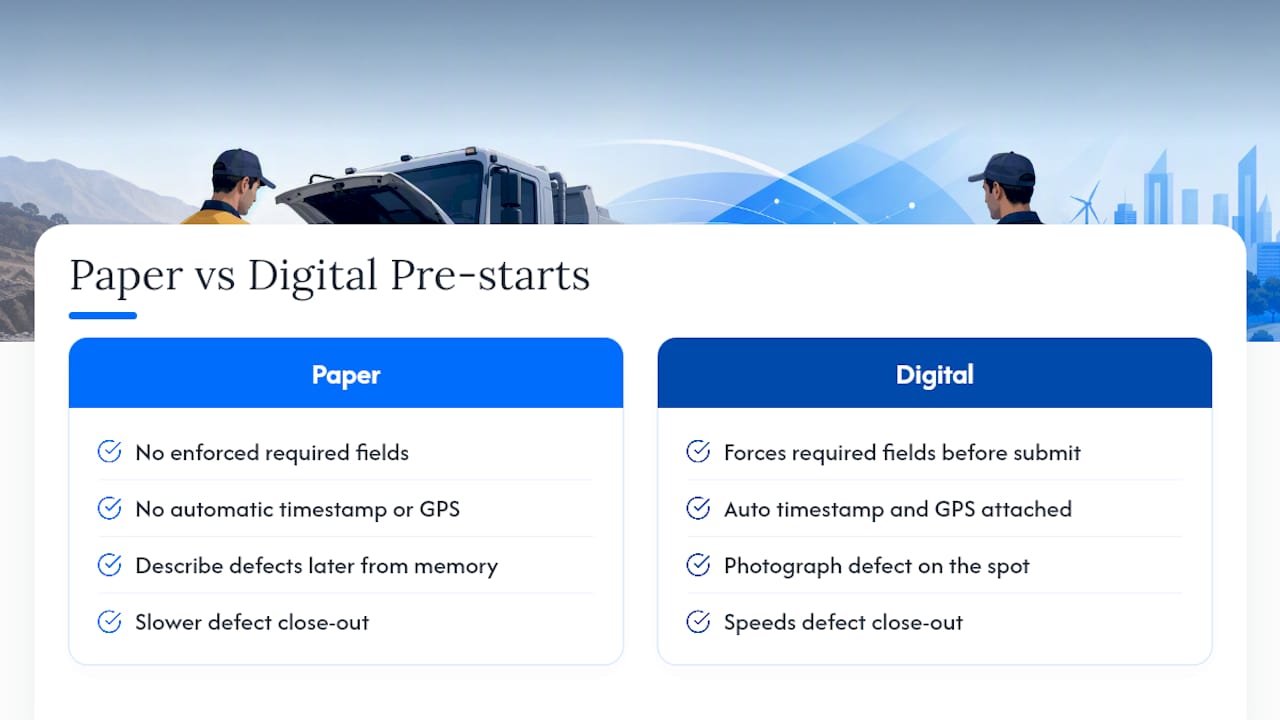
Rolling out a digital system works best with a short pilot at one depot first, a form with only the fields you genuinely need, and brief driver training before fleet-wide rollout. This is where a platform built specifically for trucking and civil operations earns its keep. Dirtchamp connects digital pre-starts with GPS tracking and compliance records in one place, so a flagged defect routes straight to the office instead of sitting in a glovebox until someone finds it.
Printable and digital templates you can use today
Grab a printable checklist template for light vehicles, or set up a simple digital form with the same fields: driver name, date, registration, odometer, OK/Issue/N/A per item, signature.
- Light vehicles: strip back to exterior, in-cab and paperwork only
- Trucks: add coupling, trailer and load checks
- Plant and machinery: add hydraulic, attachment and ground-condition checks
Why paper checklists quietly fail fleets
Most operators don’t abandon paper checklists because they hate paper. They abandon them because the paper never makes it back to the office intact, legible, or on time. That gap between “the check happened” and “the office can prove the check happened” is where compliance actually breaks down, not in the walk-around itself.
The industry’s obsession with longer, more detailed checklists gets this backwards. A twelve-page form that nobody finishes properly is worse than a one-page form drivers actually complete. Short, forced-field digital forms outperform exhaustive paper ones precisely because compliance is a behaviour problem before it’s a documentation problem.
Where digital pre-starts genuinely change outcomes is in the handoff. A defect logged on paper sits in a glovebox until someone remembers to mention it. A defect logged digitally with a photo and timestamp lands on a supervisor’s screen the same day, which is the difference between a vehicle off the road for an hour versus a week.
— Mike
Get your fleet’s pre-starts and compliance sorted with Dirtchamp
Dirtchamp is built specifically for trucking and civil operators who need pre-starts, dockets, and compliance records in one place instead of scattered across paper forms and spreadsheets.
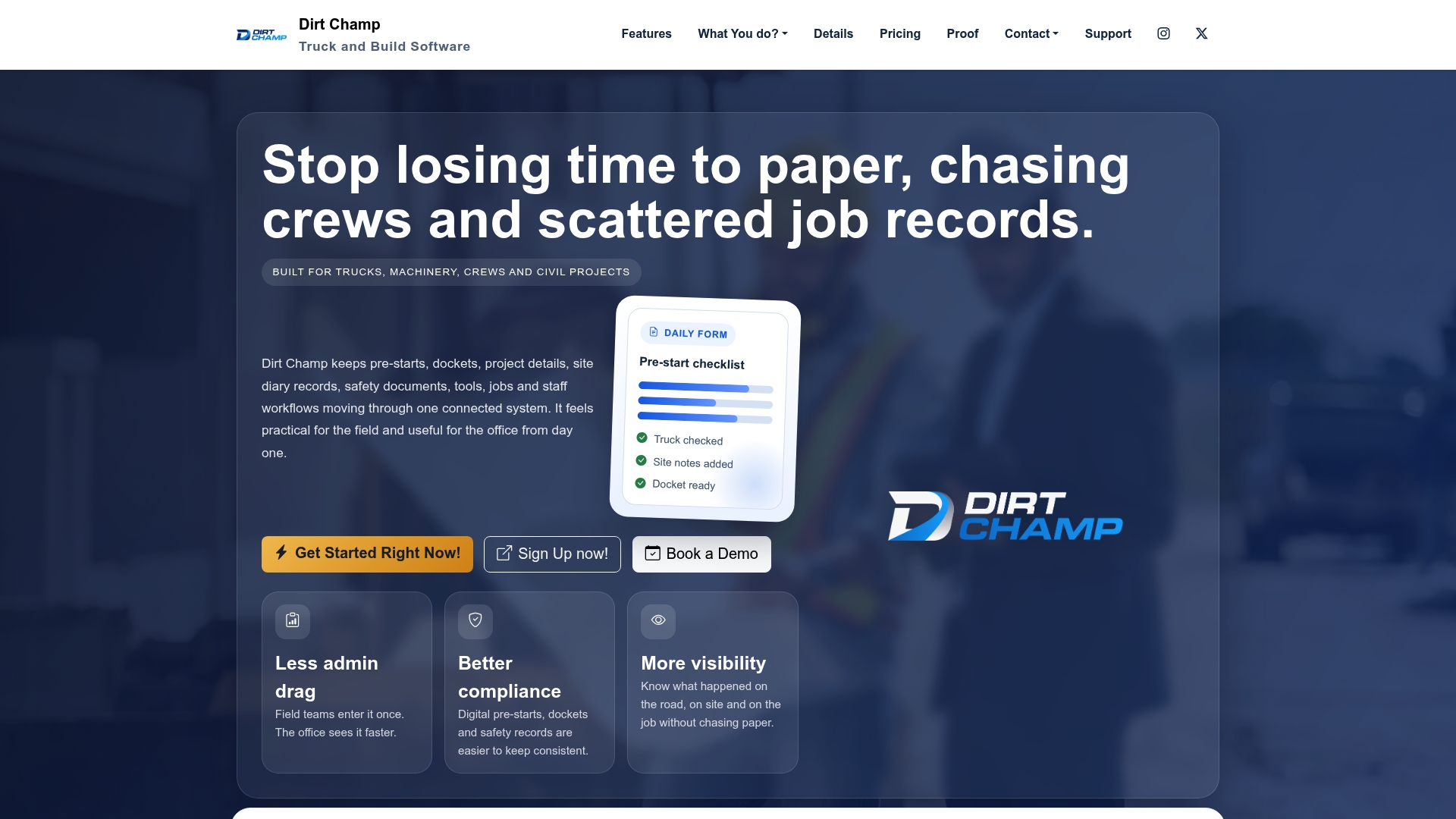
If you’re managing more than a handful of vehicles, chasing paper checklists back to the office eats hours every week that could go toward actual work. Dirtchamp lets drivers complete digital pre-starts from the cab, attaches photos and timestamps automatically, and routes flagged defects straight to your supervisors without a phone call. It also connects live GPS tracking through the OBD port, so you get vehicle location alongside compliance data without extra hardware installs. If your fleet is still relying on paper forms and manual follow-ups, see how Dirtchamp handles pre-starts, dockets and compliance in one platform and book a look at how it would fit your operation.
Sources
- Basic pre-start vehicle check
- Vehicle pre-start inspection checklist | Free template
- Light vehicle pre-start checklist: a practical guide to fleet safety and compliance
- Vehicle pre-start checklist (NTI template)
- Vehicles as a workplace (SafeWork SA)