Make NHVR fatigue records audit ready for Australian fleets

If you drive a fatigue-regulated heavy vehicle in Australia, a local area record covers work within 100 km of base under standard hours. Travel 100 km or more, or run under BFM, AFM or an exemption, and you need a National Driver Work Diary or an approved Electronic Work Diary instead. Complete entries within 24 hours, hand them to your record keeper within 21 days, and keep them for three years. None of that replaces your duty to actually manage fatigue.
TL;DR:
- Drivers exceeding 100 km under standard hours require a National Driver Work Diary for the entire day, even if they started with a local area record.
- A local area record must include the date, vehicle registration, total work and rest time for the day, and weekly totals, with no fields omitted.
- Electronic Work Diaries are equally legal substitutes for paper records and help automate timestamps and reduce entry errors, especially on long trips.
- Records must be completed within 24 hours, handed to the record keeper within 21 days, and stored for three years to stay compliant.
- Small record-keeping lapses, like missing weekly totals or late entries, are common and best prevented by building quick daily habits and using centralised digital systems.
Table of Contents
- Who NHVR fatigue records apply to and when a work diary is mandatory
- The 100 km rule: when a local area record is enough
- What must go on a local area record
- EWDs versus written diaries: what actually changes
- Timelines: completing, submitting and storing your records
- Unplanned long trips and lost diaries: what to do immediately
- Fatigue record-keeping exemptions: when they apply and what they allow
- Why good records alone don’t satisfy NHVR
- A daily compliance checklist that actually holds up under audit
- A note on where drivers actually slip up
- How Dirt Champ fits into your fatigue record-keeping routine
- Where to check the official rules yourself
- Sources
- FAQ
Who NHVR fatigue records apply to and when a work diary is mandatory
The rules apply to anyone driving a fatigue-regulated heavy vehicle, and the record keeper carries the paperwork obligation. That’s usually the employer, an accredited operator, or the driver themselves if they’re self-employed. The record keeper’s job is straightforward but non-negotiable: collect the right data, store it properly, and produce it when an authorised officer asks.
Which record you use depends on the hours option you’re driving under, not just how far you travel.
- Standard hours: local area record for work within 100 km of base; National Driver Work Diary for anything further.
- Basic Fatigue Management (BFM): work diary required regardless of distance travelled.
- Advanced Fatigue Management (AFM): work diary required regardless of distance travelled.
- Exemption hours: work diary required regardless of distance travelled.
The available hours options themselves come from the Ministerial Standard for Alternative Compliance Hours, which sets out what BFM, AFM and exemption accreditation actually allow. If your fleet runs mixed work, some standard hours jobs, some BFM runs, you need both record types available and your drivers need to know which one applies before they start the engine.
The 100 km rule: when a local area record is enough
Under standard hours, driving up to 100 km from base means a local area record does the job. Hit 100 km or more on that same standard hours job, and a National Driver Work Diary becomes mandatory for the entire day, not just the extra distance.
- Local run: a tip truck doing quarry-to-site deliveries 40 km from the depot, back and forth all day. Local area record.
- Regional job: a low loader travelling 130 km to a job site and back. National Driver Work Diary, even though the return trip technically brings you back to base.
- Mixed day: morning local deliveries, then an afternoon run past the 100 km mark. Once you cross that threshold, the whole day needs to go into the work diary.
Round trips count on total distance travelled, not distance from base at any single point. That catches out more drivers than any other part of the rule.
What must go on a local area record
A local area record doesn’t ask for much, but every field is mandatory. Leave one out and the record doesn’t meet NHVR’s standard.
- The date of the work.
- The vehicle’s registration number (or numbers, if you swap vehicles during the day).
- Total work time for the day.
- Total rest time for the day.
- Weekly totals for both work and rest.
Statistic Callout: Standard hours work within 100 km of base only ever needs those five data points, according to NHVR’s record-keeping guidance — no diary format, no per-trip logging.
If you’re a self-employed driver acting as your own record keeper, you carry extra obligations on top: your name and contact details, licence number, base location, and supporting roster and payment records. You’re also free to use a National Driver Work Diary for local work even when you don’t legally need one. Some operators do this simply to keep one format across the whole fleet.

EWDs versus written diaries: what actually changes
An Electronic Work Diary is a full legal substitute for the paper National Driver Work Diary, not a workaround or a “nice to have.” Both formats carry the same legal weight once NHVR approves the system.
- Rounding rules apply to written and electronic work diaries but not to local area records, so a driver switching between the two formats needs to understand that a local area record demands exact totals.
- EWDs automate timestamps and reduce transcription errors, which matters most on long regional runs with multiple stops.
- Lost or damaged diaries need immediate action, covered in the next section, regardless of format.
Pro Tip: If your fleet mixes local and long-distance work, standardise on one format across every driver where you can. Switching between a written diary’s rounding rules and a local area record’s exact totals is where most entry errors creep in.
Timelines: completing, submitting and storing your records
NHVR sets three separate clocks running, and missing any one of them puts you offside even if the record itself is accurate.
- 24 hours: complete local area records or work diary entries within 24 hours of finishing work for that day.
- 21 days: hand those records to your record keeper within 21 days of the relevant work day.
- Three years: the record keeper retains every record for three years, in a format that’s readable and available to an authorised officer on request.
That storage requirement isn’t passive. If an officer asks for records from eighteen months ago and you can’t produce them in a readable state, that’s treated the same as never having kept them at all.
Unplanned long trips and lost diaries: what to do immediately
Plans change. A local job turns into a 150 km run, or a driver realises the work diary is missing from the cab. NHVR has a defined sequence for both situations.
- If you unexpectedly exceed 100 km on a day you started under a local area record, start a work diary entry from midnight of that day as soon as it’s practical to do so.
- If your diary is lost or damaged mid-trip, use a supplementary work diary record for up to seven business days while you sort a replacement, and keep copies in the vehicle for 28 days.
- Report a lost or stolen diary to NHVR within two business days, and get a replacement issued within seven business days.
None of these are optional grace periods. They’re the maximum window before you’re operating without valid records, full stop.
Fatigue record-keeping exemptions: when they apply and what they allow
Exemption permits suit operators running arrangements that don’t fit neatly into standard, BFM or AFM record keeping, think unusual roster patterns or bespoke fleet monitoring systems already in place. Accredited operators and larger fleets are the typical applicants.
- Your application needs to spell out the proposed alternative arrangements in detail, not just state that your current system works.
- You’ll need to include full accreditation details and a complete list of every driver the exemption would cover.
- NHVR can attach additional conditions to the permit, and those conditions become binding the moment the exemption is granted.
- The maximum term you can request is limited to a few years; there is no permanent exemption option.
Why good records alone don’t satisfy NHVR
NHVR runs a risk-based enforcement model, and operators with consistent, automated systems for capturing and verifying data tend to come off better in audits than those relying on paper run sheets filled in from memory at the end of a shift. That’s not a minor administrative preference. In 2026, NHVR ran a national enforcement operation specifically targeting heavy vehicle driver fatigue, which tells you where compliance attention is currently pointed.
Under the Heavy Vehicle National Law, Primary Duty means Chain of Responsibility holders stay accountable if a driver is fatigued, even if every record was filled out correctly. Records prove what happened; they don’t excuse what shouldn’t have.
Statistic Callout: NHVR’s own guidance on Primary Duty obligations lists practical fatigue controls beyond paperwork: fatigue-awareness training, medical screening for sleep disorders, rosters built to avoid excessive hours, and drivers who know where to rest before they need to.
When an authorised officer reviews your records, they’re checking specific things:
- Are entries actually readable, not smudged, cryptic shorthand?
- Can you produce the record on request without a delay?
- Are all mandatory fields present, or are there gaps on busy days?
- Do timestamps line up with other evidence like GPS traces or dockets?
A daily compliance checklist that actually holds up under audit
Most fatigue record failures aren’t dramatic. They’re small gaps that compound: a missing weekly total here, a diary entry filled in three days late there. A simple daily routine closes most of that gap.
- Log a start-of-day timestamp the moment work begins, not an estimate written in later.
- Complete the local area record or work diary entry as the day’s run sheet is finished, not at the end of the week.
- Upload or hand records to the record keeper promptly, well inside that 21-day window.
- Check weekly work and rest totals add up before they’re filed, not after an officer flags them.
- Back up every record centrally, so a lost paper diary doesn’t mean a lost record.
Digital timestamps, GPS traces and centralised storage tick every box NHVR looks for: readable, complete, and available on request. That’s the exact gap software like Dirt Champ is built to close, turning driver-entered data into a searchable record instead of a shoebox of dockets.
Pro Tip: Run a monthly spot-check on five random days across your fleet. If you can produce a complete, readable record for all five in under two minutes each, your system would likely survive a real NHVR audit.
A note on where drivers actually slip up
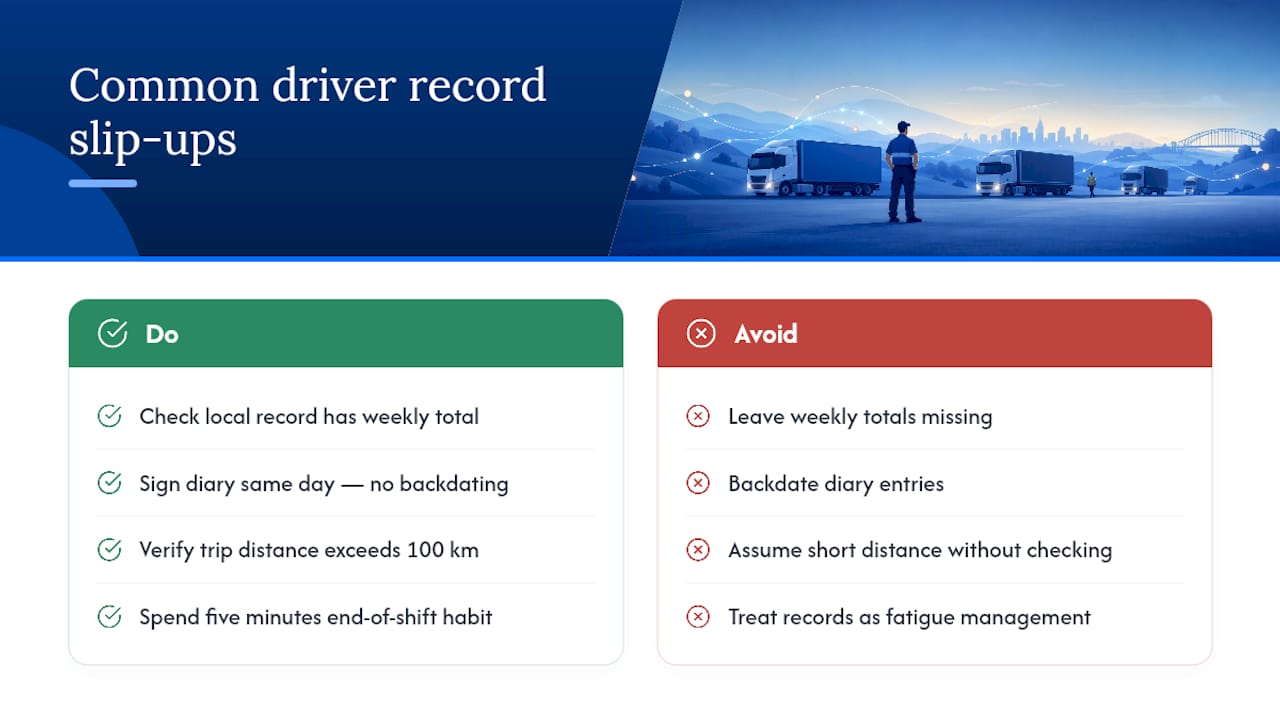
The mistakes I see repeated aren’t complicated ones. It’s the local area record missing a weekly total, the diary entry backdated three days after the trip, the driver who assumed a “quick regional run” stayed under 100 km when it didn’t. Fixing that isn’t about learning more rules. It’s about building a five-minute habit at the end of every shift.
Records don’t manage fatigue. They prove you’ve been managing it, which is a different thing entirely, and the gap between the two is where most operators get caught out.
— Mike
How Dirt Champ fits into your fatigue record-keeping routine
This software is built for the exact admin grind this guide describes, digital run sheets and dockets that replace the paper stack, automated timestamps that remove the “filled in three days late” problem, and GPS tracking through the OBD port with no complicated install. Every entry lands in one central system your office can pull up the moment an authorised officer asks, instead of chasing down a driver’s glovebox.
For fleets juggling standard hours, BFM runs and the odd exemption arrangement, that consistency is what actually helps at audit time, not just cleaner paperwork, but a record keeper who can produce three years of readable history in minutes. It also takes pressure off drivers who’d otherwise be doing fatigue admin at the end of a long shift. If your current process still runs on paper dockets and memory, book a look at Dirt Champ and see what a centralised record system does to your next compliance audit.
Where to check the official rules yourself
NHVR’s own pages are the final word on every requirement covered here, and they get updated as guidance changes.
- Record keeping requirements
- Work diary
- Electronic work diary
- Fatigue record-keeping exemption permits
- Primary Duty obligations
For exemption-specific questions, NHVR guidance directs applicants to email Fatigue.Management@nhvr.gov.au directly.
Sources
- Record keeping requirements | NHVR
- Work diary | NHVR
- Electronic work diary | NHVR
- How to apply for a fatigue record-keeping exemption permit | NHVR
FAQ
What are the record-keeping requirements for NHVR drivers?
Drivers within 100 km of base under standard hours keep a local area record with dates, registration and daily/weekly totals; anyone travelling further, or running BFM, AFM or exemption hours, needs a National Driver Work Diary or EWD.
Is there a free NHVR logbook app?
NHVR doesn’t publish its own free logbook app; it approves third-party Electronic Work Diary systems as legal alternatives to the paper diary, and fleet software like Dirt Champ builds record capture into broader daily operations rather than as a standalone diary app.
What are the new NHVR fatigue laws?
There’s no single new law rewriting fatigue rules; NHVR has instead sharpened enforcement, including a national operation targeting heavy vehicle driver fatigue in 2026, which puts more weight on operators having consistent, audit-ready records.
What is the law on fatigue management in Australia?
The Heavy Vehicle National Law sets fatigue management obligations, including the Primary Duty under Chain of Responsibility, which holds operators and drivers accountable for managing fatigue risk, not just for keeping accurate records of it.